

The Elephant In The Room
Our Society and Suicide
The old aphorism about the elephant in the room – something important and obvious that no-one is talking about – has never been more pertinent than it is for our society today. What is this giant, glaring problem, somehow managing to stay out of sight? It is a serious word beginning with the letter “s”: suicide. It is that “s” word that demands a “Triple A” rating of societal response: action, accentuation and awareness.
Indeed, suicide is more prevalent an incident than many would hazard to guess. As a boring old health economist and epidemiologist, I can assure you this matters as – in addition to equity and fairness – the level of health burden falling on a population, and in turn a besieged NHS, should be consummate to the investment and attention it receives. Given suicide is the biggest killer of men under the age of 50 years and rapidly rising in women, we could be forgiven for thinking an all-out action and emergency national strategy would be in force, that is also well advanced and fully developed, actively being implemented, and yes well-funded. Alas, it is not on all fronts. Put bluntly, that should be a source of national shock and dismay, not least given that in the UK every year we lose more than 6,000 people to suicide; the real figure is likely higher as coroner reporting and autopsies improve. The human loss is unimaginable; the economic loss and opportunity cost is enormous. This is all before accounting for attempted suicide and suicidal ideation, which have an eye-wateringly high economic burden and, more importantly, a quality-of-life loss and human impact of gargantuan proportions. Operation Triple A is needed. Yet each of us has a role to play with compassion and consideration.
Moreover, we have seen a sharp rise in teenage and young person suicides and attempted suicides, which is heart-wrenching beyond description, and when combined with the acute perils of an out-of-control internet, alarm bells really should be ringing. In fact, they should be pounding loudly and inducing a form of societal tinnitus. In addition, suicide is a high-risk factor amongst veterans, service personnel, police officers, teachers, healthcare professionals and many public servants. The idea that the status quo is okay is as lamentable as it is desperately sad. For every suicide, there is a person, a fellow human, a bereaved family and friends (whose risk of suicide also then increases), and a societal loss of opportunity that is simply not quantifiable or even describable. It is intolerable. Or to put it another way, we cannot and must not tolerate this situation, especially given most suicides are preventable. Also, it can affect anyone at anytime as case after case shows. We all have mental health and it is a one in one person imperative.
It is deeply regrettable, as the Samaritans so aptly called out this week, that the new Government’s Budget did not allocate investment to suicide prevention. Although the economics of this Budget remain deeply questionable, the mammoth additional funding for the NHS is welcomed, albeit without reform, prioritisation and critical focus the extra cash risks adding to the sinkhole of inefficiency and ineffectiveness defining an increasingly outmoded healthcare system. Indeed, despite all the brilliance and dedication of the NHS, it is still operating on 1948 principles and is really a National Illness Service dealing in sick care rather than healthcare. There needs to be a critical shift and a strategic use of future resources to turn the page. This demands a better use of science and technology, but ultimately this is a function of public health and prevention.
Prevention has been a hyperbolic word hoyed around by many a government and politician, but with a vacuity that has undermined its meaning. We are seeing governments obsess, whatever the virtues or pitfalls, with banning smoking, even outside pubs (I loathe smoking and have absolutely no sympathy for it), but the idea of stopping suicide is off the radar, barring the occasional tokenistic footnote as part of broader health debates. The order of magnitude of prioritisation, or as Albert Einstein might call it, the relative degree of focus, is the wrong way round and inverted to a level of irrationality. Actually, in the case of smoking, given all the public health education, advertising and legal constraints, and rightful demonisation of nicotine, the irony is most people who still smoke are doing so for stress-related reasons. To put it another way, mental health reasons and smoking is arguably a form of self-medication. What about tackling the root causes and underlying mental health challenges? A novel idea but one with serious pay-off. The reframing of public health, what it means and why prevention is so urgently needed is the real challenge and stuff of modern health policy. It is here the opportunity is big, bountiful and even exciting.
Yet for this opportunity to be grasped, and the dream of real health “levelling up” to be taken, we have to accept a simple truth: that “health” is bigger and wider than the NHS and is actually a societal reality. And, more to the point, “health conversations” invariably take place in locations outside of the GP surgery or hospital. The truth is they take place down the pub, in the sports dressing room, the gym, the coffee shop, the morning club, around the dinner table, the workplace. In short, anywhere and everywhere. In the context of suicide prevention, this has specific resonance and fact. Sadly, our health system is not match-fit to handle this because we are not investing in public health properly and constantly shifting responsibility onto a dilapidated NHS. Hence why a national suicide-prevention strategy is needed that is genuinely government, institution and society-wide. Society is ready for the challenge, but needs leadership. We must all step up to that call and, where we can, even take on the “captain’s armband”. For this is a battle we can win. UK Society FC can bag the end-of-season trophy, but like anything, it needs hard work, dedication, resourcing and commitment. There is no magic wand for success.
We have reasons to be optimistic. I am always glass-half-full. In fact, I am glass-brimming-over-the-top. Why? Because the situation demands it, and hope – arguably the most powerful of all emotions – calls for it. Furthermore, we have made great strides on the core issue of mental health. We only have to go back 10 years, certainly 20 years, and mental health was a taboo subject, marginalised to the fringes, an unspoken truth, and an example of social awkwardness horrendously mischaracterised as weakness and cowardice. Today, it is now mainstream, talked about, encouraged with openness, and actually seen as a positive with professional sportspeople, athletes, celebrities and others calling it out as seminal to performance-enhancement and yes, success. To be clear: talking, being open and raising awareness is strength. Towering strength in fact. That is the carrot. We can displace one “s” (suicide) with another “s” (success), which can come through another collective “s” (strength, which really means openness). Just imagine how good a zero-suicide society would be or at least a “top 4” Champions League finish. Martin Luther King Jnr once said, “the arc of the moral universe is long, but bends towards justice”. Well, for those who have fallen to suicide, we owe it to them. As a society, we owe it to stop that feeling of isolation, helplessness and hopelessness. We must never stop fighting for mental health and suicide prevention. It is frankly too important.
Thus, it should be a no-brainer (no pun intended) that we need a national mental health strategy which is fully funded and resourced. The pandemic, cost of living crisis, kaleidoscopic international events, and the rampant hazards of a social-media-driven world with all its complexities and after-effects place this as one of the biggest health challenges of any generation. We are seeing children grow up in a digital age which demands more regulation and safeguarding amidst obvious damage and harm. Yet, underpinning this must also be a national suicide-prevention strategy. Without it, we are simply letting the loudest, noisiest and most devastating elephant of all – suicide – to cause societal carnage. In a way, the complicated thing is keeping the approach simple. By placing and focusing the lens on this imperative, we can encourage society to talk more about suicide and normalise its reality. Difficult thoughts, negative emotions and even suicidal ideation are commonplace and normal, even if flickering and ephemeral. Strength is to be open and for all of us to listen. Together, the elephant can be taken down.
The Government has said it wants to be mission-based. There is one critical mission it needs to add. As the Baton of Hope so eloquently has put it, “[we] will simply not tolerate more than 6,000 suicide deaths per year in the UK (as currently) when most suicides are preventable”. Spot on. I will continue to lend my support and carry that baton. It really matters. Volunteering and being part of this means so much. Please do so too. Because together, we win. With you, together we absolutely will win.
Stuart Carroll is a senior health economist and epidemiologist who is also a mental health and suicide-prevention first-aider. He is a former special adviser to The Baton of Hope and a lifelong mental health and suicide-prevention campaigner. Stuart works in the life sciences and healthcare sector for Moderna, but is writing this article in a purely independent capacity.
Stay Updated
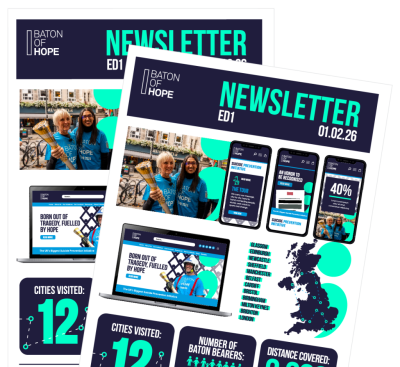
Sign up to our newsletter to receive the latest updates from The Baton of Hope direct into your email inbox. Use the form below to sign up to our newsletter.